Start with the toys, not the containers
Before buying bins or rearranging a room, notice where play happens. Do blocks migrate to the rug? Do drawing supplies end up at the kitchen table? Storage near those spots will usually be easier to use than a perfectly ordered shelf across the room. The goal is not to make every toy visible at once; it is to make the next step after play obvious.
Gather toys into broad groups that a child can recognize, such as building pieces, pretend-play items, vehicles, art supplies, and soft toys. If one group fills several containers, consider keeping a smaller selection within reach and storing the rest elsewhere for later. Set aside broken items and toys that are no longer used. Fewer choices can make both choosing a toy and returning it to its place less complicated.
Give each group a home a child can use
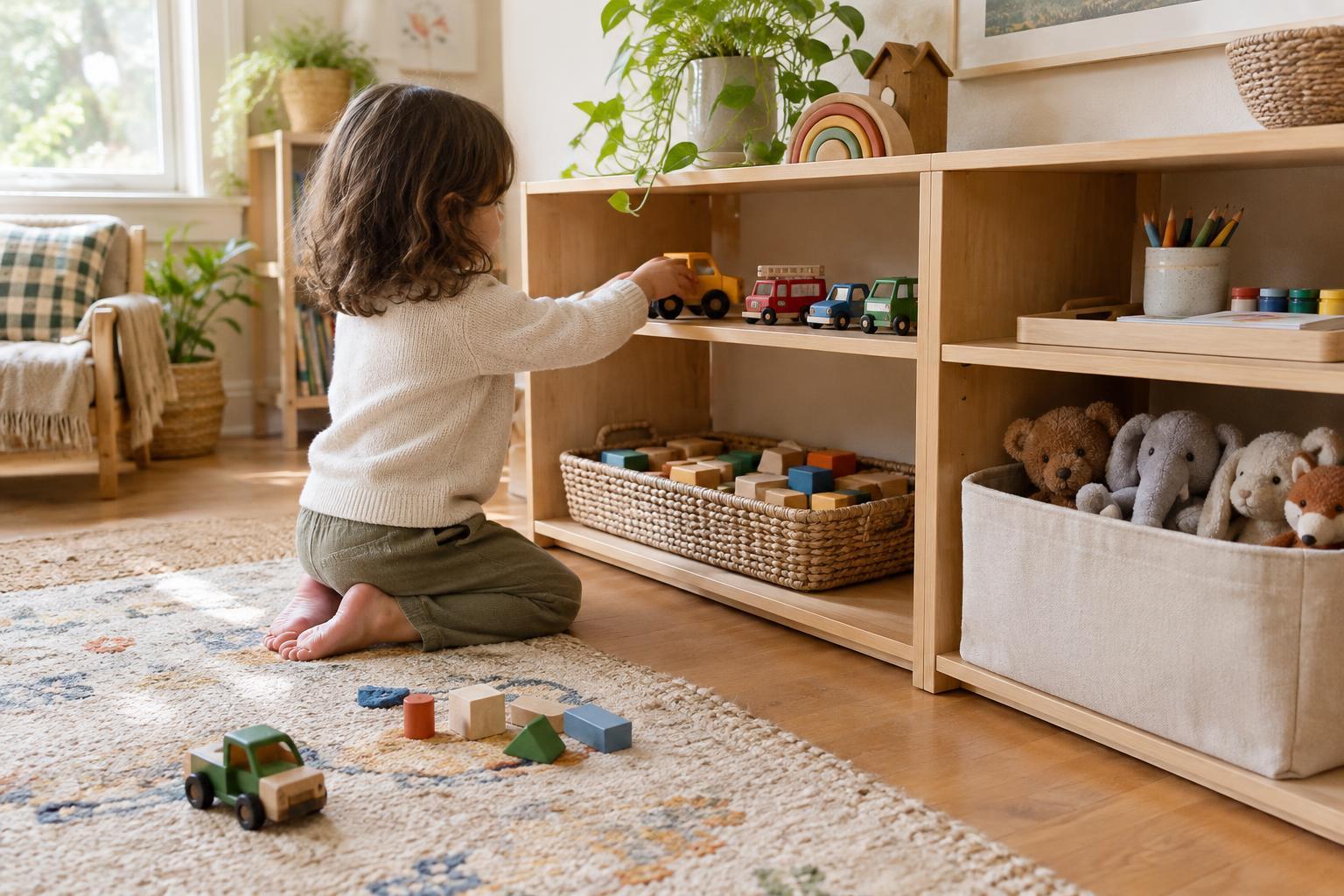
Put frequently used toys on low, accessible shelves or in lightweight open bins. A child should be able to remove a container and return it without lifting a heavy load or navigating a stack. Reserve higher storage for items an adult manages, such as spare supplies or activities that need supervision. Follow furniture instructions, and secure shelving or other tip-prone furniture as appropriate for the space.
Choose containers for the job they do. A shallow tray can keep a small set of figures together while making every piece easy to see. A roomy basket suits soft toys, which do not need precise sorting. Deep boxes may hold a lot, but their contents can be difficult to find without emptying them. If a toy has many parts, keep those parts together in one manageable container rather than spreading them across the room.
Make the destinations easy to recognize
Labels turn storage into a simple matching task. For a child who is not yet reading, use a picture of the toy type or one familiar example alongside a word. Place labels where they remain visible when the container is on the shelf. Specific labels such as “blocks” and “cars” are often more useful than a row of boxes all marked “toys.”
Keep the number of categories modest. Sorting every animal, vehicle, and character into a separate bin may look tidy, but it asks for many decisions at cleanup time. A broad “small figures” bin may work better. You can refine a category later if it becomes too crowded or if a child consistently looks for one group on its own. The best arrangement is one that can be followed on an ordinary, tired afternoon.
Design a short path from play to put-away
Think about the physical steps involved in cleanup. A bin tucked behind a door, under another bin, or behind a lid creates an extra task before any toy goes away. Leave space in front of shelves, avoid stacking everyday containers, and make sure each toy group has enough room to be returned without careful packing. A little unused space is helpful: it lets a child drop pieces in rather than solve a storage puzzle.
Small boundaries can also make the room easier to reset. A tray for a tabletop activity or a defined patch of floor for building gives loose pieces a place to gather during play. When it is time to stop, the child can work through one area at a time. For toys used in several rooms, a portable basket can bring them back to their usual home; it need not become another permanent place where they disappear.
Test the system together and adjust it
Introduce the arrangement by putting away a few toys with the child, rather than explaining the whole room at once. Ask where they expect a toy to go and watch for points of friction. If they cannot identify a bin, change its label. If they cannot reach a shelf comfortably, move the toy. If a category overflows every day, give it more space or reduce what is kept out. These observations are more useful than insisting on an arrangement that only works for adults.
A workable system does not require a spotless room. It gives children a reasonable way to participate, even when they still need help. Revisit the layout as interests and abilities change: a once-favorite toy may move into storage, while a new activity may deserve the easiest shelf. When homes for toys reflect how they are played with, putting them away becomes a familiar final step rather than a separate organizing project.