Start with the work, not the storage
Kitchen utensils tend to collect wherever there is room: a spatula in a drawer, a whisk in a jar and measuring spoons hanging from a hook. That arrangement may fit the tools, but it does not always fit the way you cook. A more useful starting point is to notice the tasks you repeat: preparing ingredients, cooking at the stove, baking, serving and cleaning up.
Empty one utensil drawer or crock at a time and sort its contents into those task groups. Put tools used for more than one job with the task where you most often reach for them. The aim is not a perfect classification. It is to make the next place you look the place where the tool is likely to be.
Give each task a nearby home
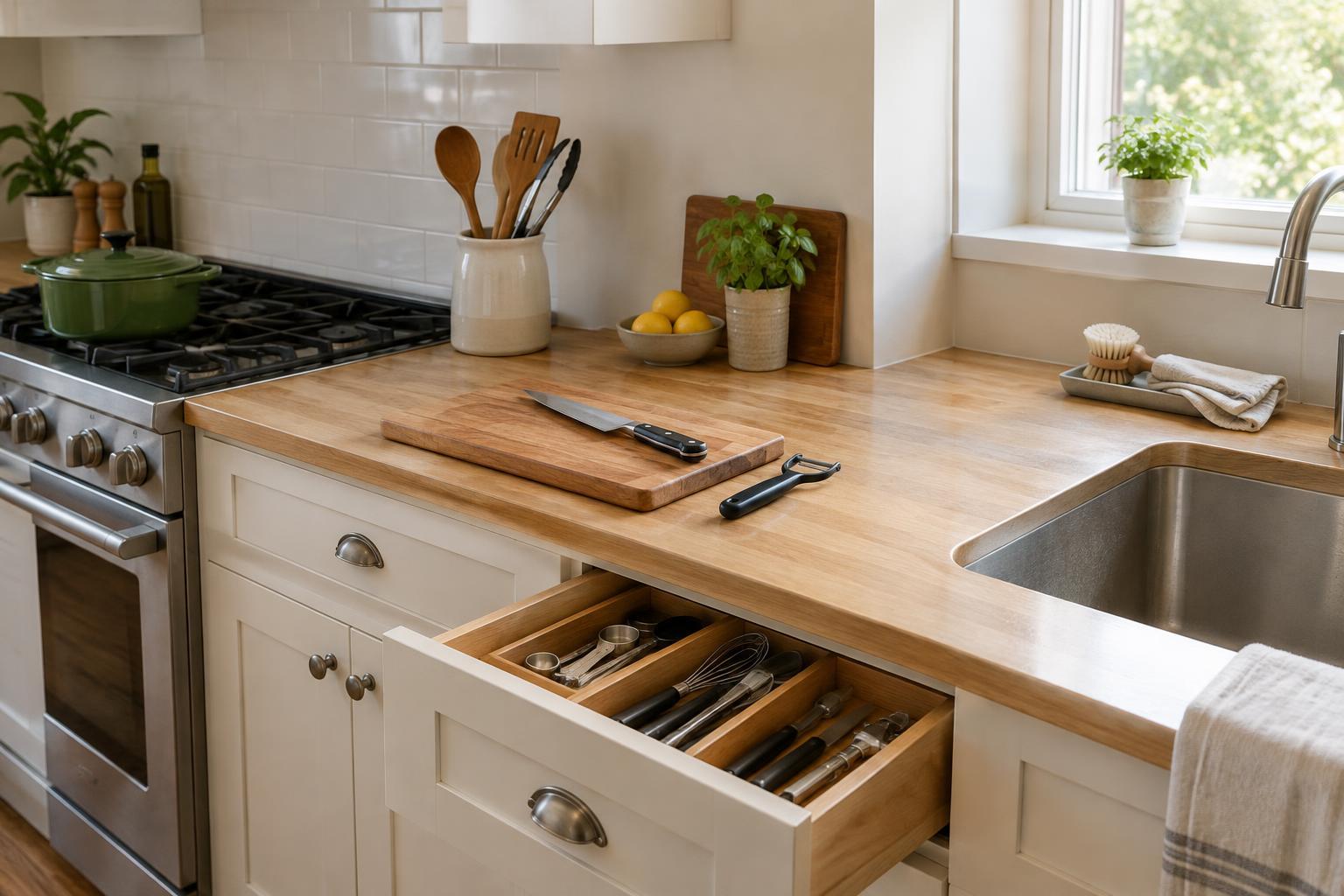
Place prep tools near a clear stretch of worktop if the kitchen allows it. A drawer there might hold peelers, kitchen shears, measuring tools and small spatulas. Cooking tools belong within comfortable reach of the stove, but they do not all need to stand beside it. A nearby drawer can hold tongs, turners and stirring spoons while leaving the counter free for ingredients and pans.
Keep serving tools close to the dishes or dining area rather than automatically placing them with cooking tools. Baking tools can share a drawer, bin or cabinet shelf if they are used together. When a task spans several parts of the kitchen, choose the spot where you usually begin it. That gives the group a predictable home even when the layout is imperfect.
Make counter space earn its place
A utensil crock is convenient, but it can become a crowded display of tools that rarely leave it. Try limiting counter storage to a small set used on most cooking days. A stirring spoon, turner and tongs may be enough; the right selection depends on what you make. Store the rest in a drawer or cabinet, then adjust the set after living with it for a while.
Choose a container with enough width that handles are easy to grasp without lifting out a bundle. Position it where it will not interfere with the space you need to set down a cutting board or plate. If the stove area is tight, a drawer within a step or two can be more practical than a crock squeezed against the burners. Keeping tools away from direct heat and splashes also makes the storage easier to maintain.
Use drawers and vertical space selectively
Inside a drawer, broad divisions often work better than a fitted slot for every object. One compartment can hold flat turners, another small prep tools and another measuring items. Allow space for handles and unusual shapes; a divider that looks tidy when empty may be frustrating when the drawer is full. Shallow trays or small boxes can create groups without requiring a permanent installation.
Hooks or a rail can help when drawers are scarce, especially for a few tools with hanging loops. Leave enough room to take down one item without knocking the others. Before adding wall storage, check whether it will crowd a workspace or make cleaning awkward. Vertical storage is useful when it improves access, not simply because it exposes more utensils.
Keep the system easy to reset
Duplicates and specialized tools deserve a separate look. If several utensils do nearly the same job, keep the ones that feel comfortable and work with your cookware. Place occasional-use pieces together in a less prominent drawer, cabinet bin or shelf rather than mixing them among daily tools. You will still know where to find them, and the most accessible spaces will remain easier to use.
Finally, test the arrangement during ordinary meals. Notice where you pause to search, where a drawer gets jammed and which tools repeatedly land on the counter after washing. Those are clues that a group is in the wrong place or has grown too large. Small changes are usually enough: move the tongs closer to the stove, shift the measuring cups toward the prep area or take one rarely used tool out of the crock. A good system makes putting things away nearly as simple as taking them out.