A useful notebook from a few simple parts
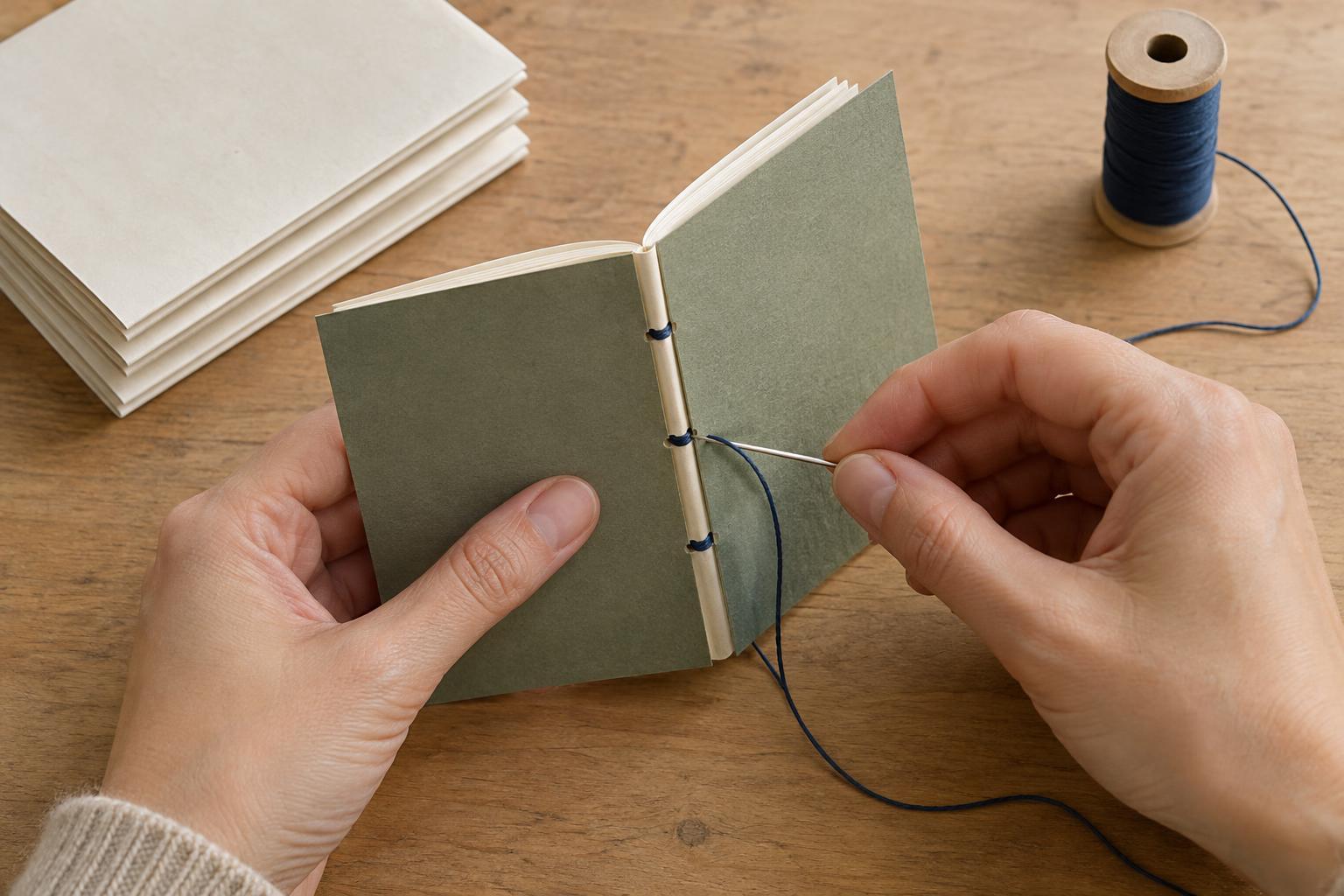
A pamphlet stitch is a good way to bind a notebook made from one group of folded sheets. The pages sit inside a folded cover, and thread passes through three holes along the spine. Unlike a glued pad, the finished book can open comfortably for writing or sketching. Its construction stays visible, too: the line of stitches on the outside shows how the object is held together.
For a small notebook, gather six to ten sheets of writing paper, one sheet of slightly heavier paper for the cover, sturdy thread, a needle, a ruler, a pencil, and a bone folder or the back of a spoon. You will also need an awl or other suitable paper-piercing tool and a scrap board or cutting mat to protect the table. Choose paper that folds without cracking. If the cover is stiff, score its fold lightly before bending it.
Fold and nest the pages
Decide on the notebook’s finished size, then cut each sheet so it is twice as wide as a page. For example, a sheet that is 20 cm wide becomes a notebook about 10 cm wide when folded. Fold the sheets one at a time, bringing their short edges together, and press each crease firmly. Folding individually makes the edges easier to align than folding a thick stack at once.
Nest the folded sheets inside one another, then place the group inside the folded cover. This single nested group is called a signature. Its inner pages may extend a little farther than its outer pages; that is a normal result of nesting folded paper. You can leave the stepped edge as it is or trim it carefully after binding. Before making holes, check that the pages face the way you want and that the cover reaches around the whole signature.
Mark and pierce three holes
Open the assembled notebook to its center. Along the fold, mark one hole at the midpoint and the other two an equal distance toward the top and bottom. Keep the outer holes comfortably away from the ends of the spine; about 1 to 1.5 cm works for many small notebooks. Even spacing helps the thread hold the pages without putting too much strain on either end.
Hold the cover and pages together so their folds stay aligned. Place the open notebook over your protective surface and pierce straight through the center mark, then the top and bottom marks. Work slowly and keep your supporting hand clear of the tool’s path. The holes only need to be large enough for the threaded needle to pass through. If the stack shifts, realign it before continuing rather than widening a misplaced hole.
Sew the pamphlet stitch
Cut a length of thread about three times the spine length and thread the needle. Leave the end unknotted. Starting inside the notebook, pass the needle through the center hole to the outside, leaving a short tail inside. From the outside, enter through the top hole. The thread now runs along the upper part of the outside spine.
Next, carry the needle down inside the fold and pass it out through the bottom hole. On the outside, return through the center hole. You should now have both loose ends inside the notebook and a long strand running between the top and bottom holes along the inside fold. Bring the returning end to the opposite side of that long strand from the starting tail. Tie the two ends together over it with a firm square knot, snug enough to hold the pages but not so tight that the paper puckers. Trim the tails to a short, tidy length.
Check the binding and make it your own
Close the notebook and smooth the fold with your fingers. Open it again to check that the center pages are caught by the thread and that the cover sits evenly around them. If the stitches feel loose, retie the knot before trimming the ends further. If the paper buckles near a hole, ease the knot slightly. A neat result comes from steady tension, not from pulling as hard as possible.
Try changing one material at a time on your next notebook. Smooth paper suits quick notes, while a cover cut from a reused folder can give the book more structure. Contrasting thread makes the stitch a visible detail; matching thread lets the cover take the lead. Once you understand the three-hole path, you can make a notebook sized for a bag pocket, a recipe collection, or a small set of sketches.