Start with the likely failure
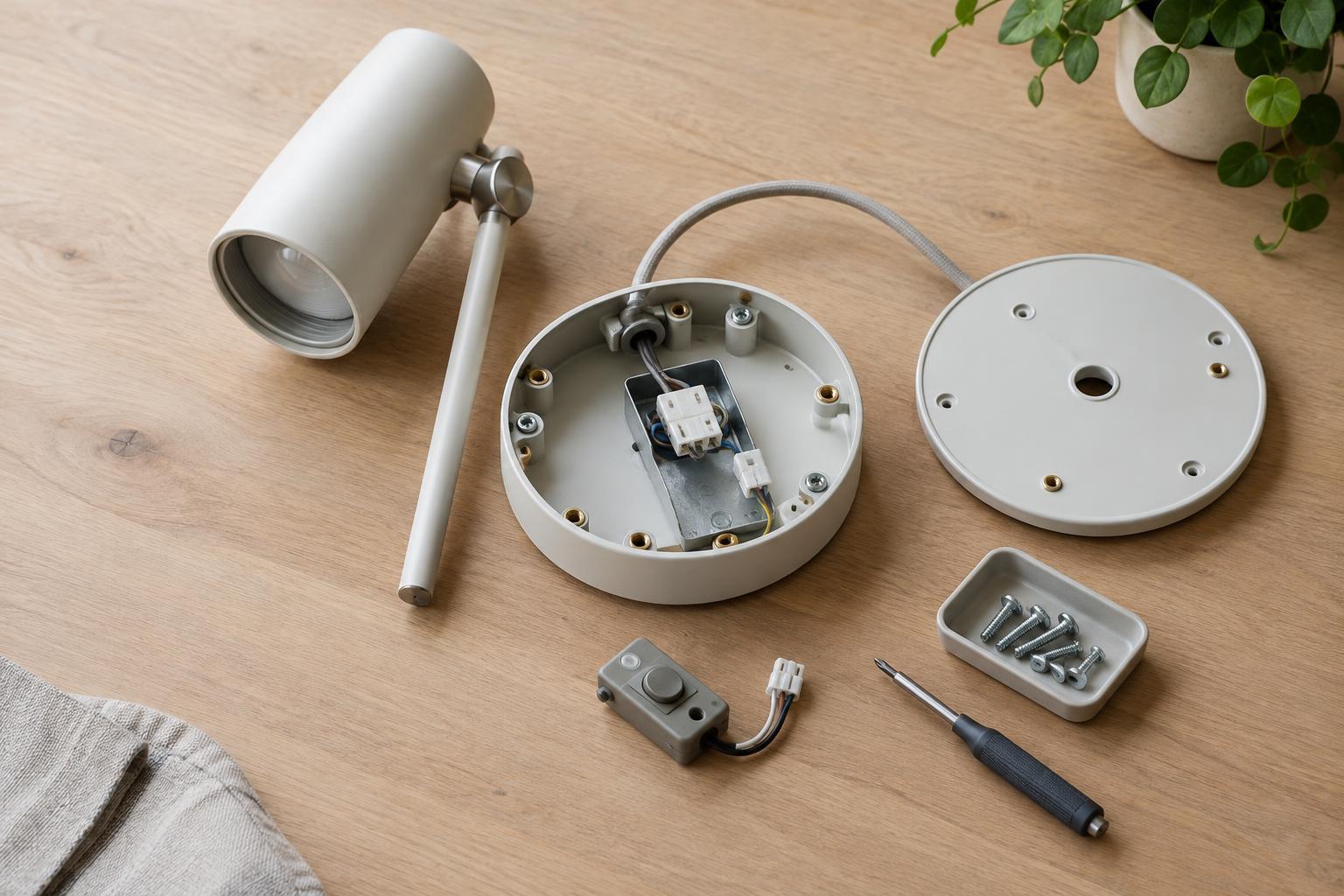
An everyday object rarely wears out all at once. A drawer pull may loosen while the drawer remains sound. A desk lamp may need a new cord or switch long before its shade becomes unusable. Designing for repair begins by asking which parts people touch, bend, turn, or move most often, then considering how those parts could be reached and replaced.
This does not mean every component must come apart. A sealed joint may be appropriate where water resistance, hygiene, or structural strength matters more than access. The useful question is whether a part likely to need attention has been permanently trapped behind parts that are still in good condition. Thinking through a simple repair sequence early in the design process can expose that problem before the object’s shape is settled.
Choose fasteners that can be used again
A fastener is a promise about how an object comes apart. Screws, bolts, and threaded inserts can make repeated opening possible when they are sized for the material and placed where a tool can reach them. Snap fits can make assembly quick and keep the exterior clean, but small tabs may break if their release points are hidden or if they must bend sharply during removal. Adhesives can create neat, strong bonds, yet they may turn a minor repair into a destructive one.
The choice also affects reassembly. A screw driven repeatedly into a soft material may eventually lose its grip; an insert or a replaceable nut can offer a more durable connection. Using a small number of consistent fastener types reduces confusion, while visible or clearly located fasteners help someone begin without prying at the wrong seam. If a fastener must be concealed, its cover should come off without being ruined.
Make access part of the layout
Opening an object should lead to the component that needs attention, not to a maze of unrelated parts. A removable back panel on a clock, for example, is useful when it exposes the mechanism without requiring the hands, face, and housing to be separated. The same principle applies to furniture: a chair seat that detaches from below is easier to re-cover than one buried beneath permanent trim.
Access depends on ordinary details. A tool needs room to turn. A panel needs space to lift away. Wires and small pieces need enough slack or restraint that they are not pulled loose as the housing opens. Internal parts should have obvious orientations, and connectors should be difficult to mix up. These choices may add little to the appearance of a finished object, but they can determine whether a careful person can work on it without causing a second problem.
Some repairs, particularly those involving mains electricity or other hazards, are not suitable as casual projects. Accessible design still helps a qualified repairer do the work. It does not require treating every interior as safe for everyone to open.
Design parts that can be replaced on their own
A replaceable part is most helpful when its boundaries match the likely repair. If a worn foot pad can be removed without replacing an entire stool leg, less of the object is discarded. If a frequently handled knob is a separate piece rather than part of a large molded shell, damage to the knob need not end the life of the shell.
Replacement also depends on whether a part can be identified and fitted. Clear dimensions, an unambiguous orientation, and a connection that tolerates normal assembly variation all help. Commonly available sizes may improve the chance of finding a substitute, though they are not suitable for every design. For a one-off project, saving a simple drawing or template can make a future replacement easier to produce. Where a component cannot reasonably be standardized, keeping its removal independent of surrounding parts is still valuable.
Test the repair, not just the assembly
An object that is easy to assemble in a workshop may be awkward to repair after years of use. Before calling a design finished, imagine a loose fastener, a cracked cover, or a worn moving part. Can the relevant piece be found? Can it be removed with familiar tools? Will neighboring surfaces be scratched or stressed? Can the object go back together securely?
A simple prototype can reveal answers that a drawing misses. Open and close it more than once, noting where clips catch, tools slip, or parts need to be held in place simultaneously. Repairability is not a single feature added at the end. It is the result of many small decisions that make continued use a realistic option.