Start with the material and the task
A making space can look tidy while still having an air-quality problem. Sanding sends fine particles beyond the workbench. Spraying a finish creates a mist. Heating or gluing materials may release vapors that are hard to see. The useful first question is not simply “Do I have a fan?” but “What will this task put into the air, and where will it go?”
Before starting, check the product label and any available safety information for the material, adhesive, coating, or tool. Pay attention to warnings about ventilation, dust, heating, and indoor use. If you cannot identify a material or understand its precautions, avoid cutting, sanding, burning, or heating it until you can. Changing the method can also help: a pre-cut part, a water-based product where suitable, or a brush instead of a spray may reduce what becomes airborne.
Catch dust where it begins
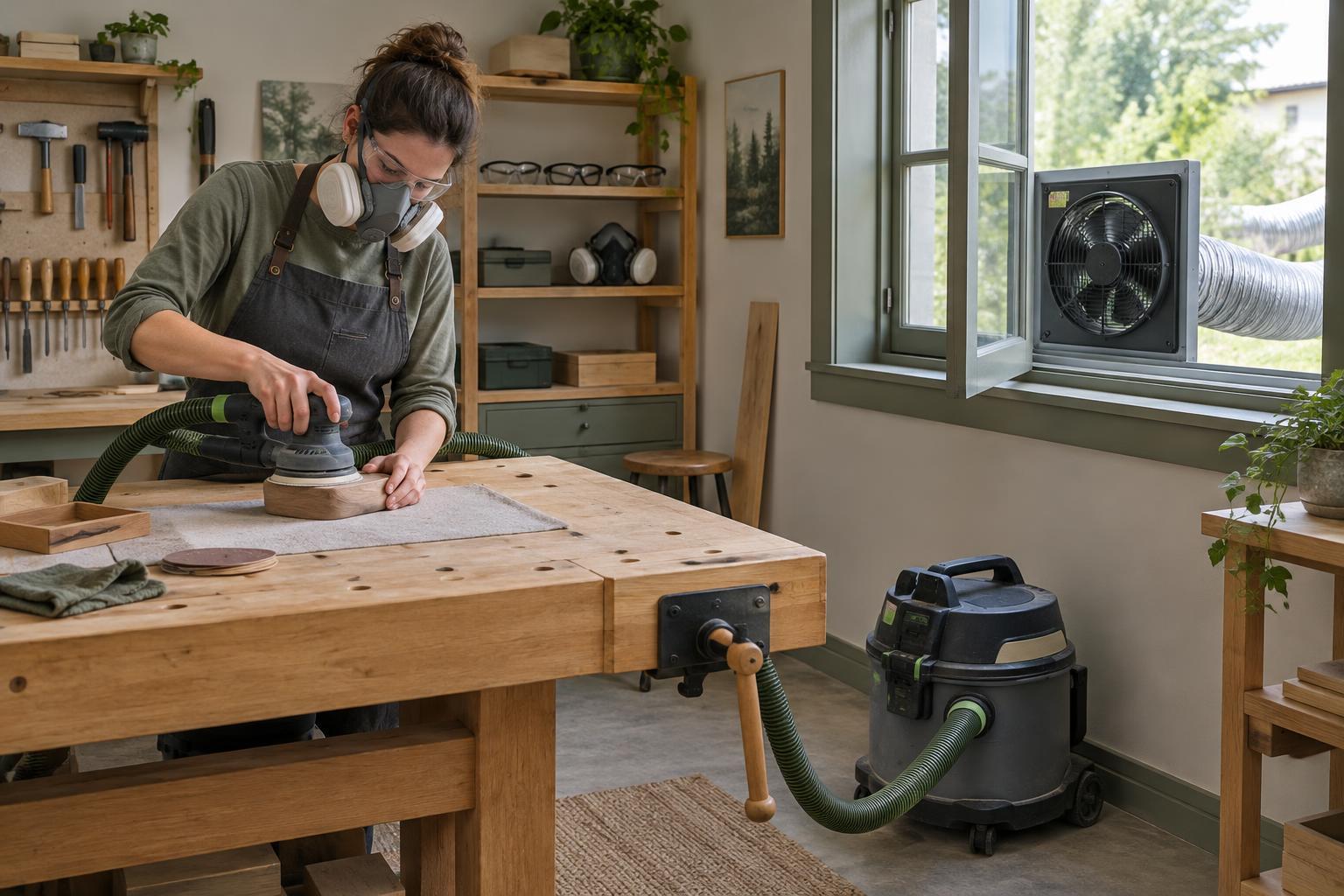
For sanding, sawing, and drilling, collection close to the tool is generally more useful than trying to clean the whole room’s air afterward. A tool designed to connect to a compatible dust extractor can capture much of the debris before it spreads. A vacuum fitted with a suitable fine-particle filter is preferable to an ordinary household vacuum for fine workshop dust. Check the tool and extractor instructions for compatible connections and materials; not every collector is suitable for every kind of dust.
Layout matters too. Keep dusty tasks away from open shelves, fabrics, and the place where you eat or relax. Close doors to adjoining rooms when appropriate, and avoid pointing a fan across the workpiece: it may blow particles into your breathing area or farther into the home. Do not rely on visible cleanliness as proof that fine dust has cleared.
After work, let collection equipment finish its job, then clean surfaces with a suitable vacuum or damp cloth. Dry sweeping and compressed air can put settled dust back into circulation. Store dusty offcuts and used wipes in a way that keeps them from shedding particles during the next project.
Give fumes and vapors a route out
Dust collection and vapor control are different problems. A filter that catches particles may not remove vapors from solvents, finishes, or adhesives. For a product that calls for ventilation, the goal is to move contaminated air away from the person working and out of the occupied space, while allowing replacement air to enter. An open window alone may not create a reliable path, especially if air drifts back across the workbench.
Think through the entire route before placing a fan. Air discharged toward a neighbor’s window, a shared hallway, or an air intake creates a new problem. A recirculating room purifier may help with some particles if it is appropriately sized and filtered, but it is not a substitute for an exhaust arrangement required by a product’s instructions. If you cannot provide the ventilation a process requires, choose another material, another method, or a properly equipped location.
Be especially cautious with sprays, strong solvents, and processes that produce substantial smoke. Keep ignition sources away from products labeled flammable, and do not assume a household fan is suitable for use around flammable vapors. Combustion tools bring additional hazards that ordinary dust-control equipment cannot address; follow their instructions and do not use equipment intended for outdoor operation inside.
Treat protective gear as a backup, not a room plan
A face covering or respirator does not make an unsuitable workspace safe. Respiratory protection must match the hazard, fit properly, and be used according to its instructions. A particle filter and a cartridge intended for particular vapors serve different purposes, and neither should be chosen by guesswork. Gloves and eye protection can matter too, but they do not control what others in the space may breathe.
Plan for the people who are not making the object. Keep children, pets, and bystanders away from active work and cleanup. If a project shares space with sleeping, cooking, or everyday living, favor methods that create less airborne material. When a material’s requirements exceed what the room can support, pausing the project is a sensible design decision.
Build a repeatable setup routine
A safer space is easier to maintain when setup is part of the project rather than an afterthought. Before each task, identify the material, read its precautions, position collection or ventilation, and clear a path for cleanup. Check that hoses, filters, and exhaust routes are in working order. During the task, stop if dust visibly escapes collection, airflow changes, or fumes linger where people are working.
At the end, clean the bench and nearby surfaces, close containers, and put tools away without spreading residue. A small, well-planned work area can be more useful than a larger one that depends on an open window and good luck. The aim is not to make every process possible at home; it is to make informed choices about which projects belong there.