Start with the books, not the bookends
A desk collection has different demands from a full bookshelf. You may pull out one reference book several times a day, leave a gap while it is open, and put it back without rearranging the whole row. The right bookends need to support the books during those small changes, not only when the row is packed tightly.
Look at the books you actually keep within reach. Tall, heavy volumes put pressure higher up a bookend than short paperbacks do. Thin manuals and notebooks may slip into spaces between a bookend and its base. If your group includes both, choose support that reaches well up the side of the tallest book and has no large opening near the desk surface. Leave a little room in the row so books can be lifted out rather than dragged across the desk.
Understand what keeps a bookend in place
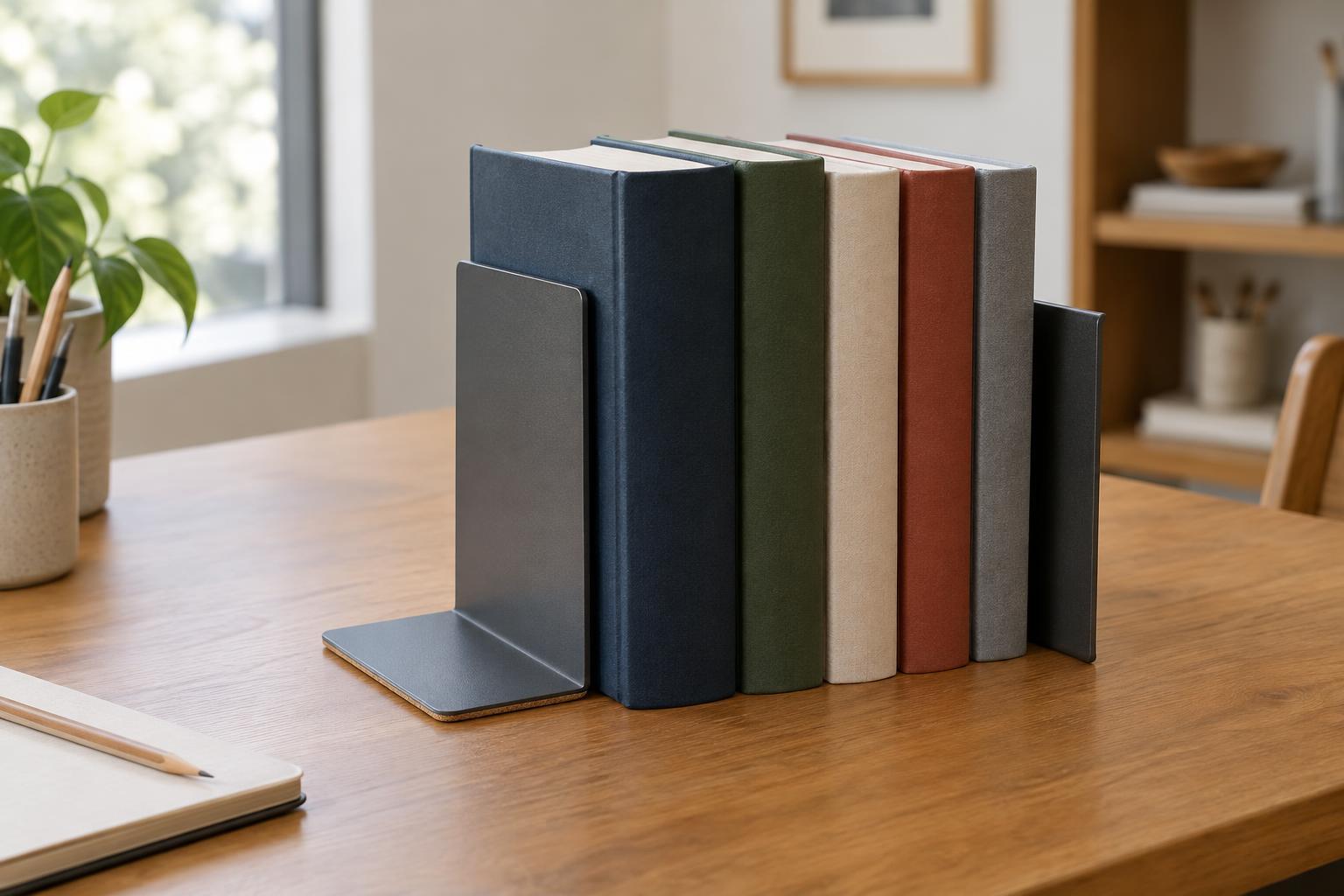
Bookends generally resist a leaning row in two ways: their own weight, or the weight of books resting on a horizontal foot. A heavy freestanding bookend can work well for a short row, provided its base has enough contact with the desk and does not slide easily. A slim L-shaped bookend relies more on its foot sitting beneath one or more books. It can save space, but it works less well if the books are too light to hold that foot down.
Consider the direction of force as well as the bookend’s weight. When books lean outward, they push near the upper part of the support. A narrow base or low back may tip before it slides. For tall reference books, favor a bookend with a broad base and a back that supports a useful portion of the cover. Two effective bookends are also better than using a wall of desk equipment as an accidental stop: the books remain easier to move, and nearby objects are less likely to be knocked over.
Match the base to your desk surface
A smooth desktop can let a rigid bookend creep outward, especially as books are removed and returned. A non-slip underside can help, whether it is built in or added as a removable pad. Check that any pad makes even contact and does not cause the bookend to rock. On a textured surface, a broad, stable base may matter more than a very grippy material.
Protecting the desk is part of the choice. Examine the underside for sharp corners, exposed fasteners or rough edges, particularly on metal bookends. A protective layer may be useful on a surface that scratches easily, but it should not leave a bookend unstable. If you use a desk mat, test the bookends on the mat rather than assuming they will behave as they do on the bare desk.
Choose a shape that suits daily use
A simple vertical face usually makes it easiest to return a book without catching its cover. Decorative projections and open shapes can be attractive, but check where they touch the books. A support that presses on a small point may leave the row uneven; one with a smooth, reasonably continuous face gives covers a clearer surface to lean against. Rounded or finished edges are also more comfortable when you reach past the bookends frequently.
Footprint matters on a desk. Deep bookends can compete with a keyboard, lamp or writing area, while very small ones may not support the books you own. Before buying, mark out the intended space with paper or a ruler. Include the full width of the books and both bookends, and check that you can still reach the volume at either end. If you expect the collection to grow, reserve a modest amount of extra space rather than choosing a much larger setup than you need now.
Test the arrangement before calling it finished
Set the bookends on the desk and stand the books between them, with the heaviest volumes near a support. The row should sit upright without needing to be squeezed tightly. Remove a book from the middle, then one from an end. If the remaining books lean sharply, the bookend moves, or the foot lifts, adjust the spacing or try a more stable design. This quick test reflects ordinary use better than judging an untouched row.
Bookends work best when they support a manageable group, not an overfilled line that is difficult to browse. If one pair struggles to hold a long collection, split the books into smaller groups or move less-used volumes elsewhere. The result should feel calm and practical: reference books visible, easy to retrieve, and able to stay upright when one is on your desk.