Start by reading the board
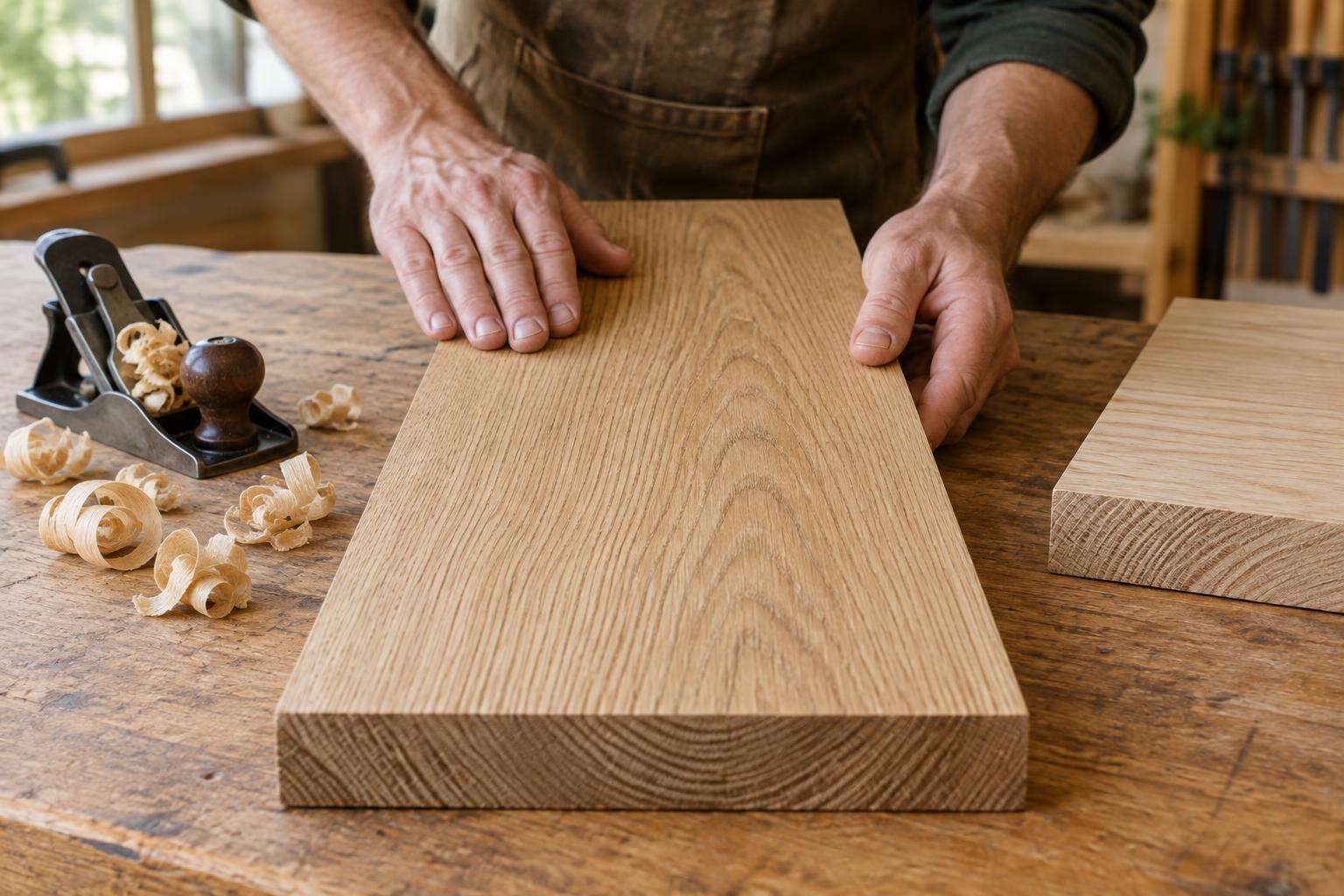
Wood grain is the visible expression of how a tree grew and how a board was cut from it. The long fibers generally run along the board’s length, while growth rings appear as lines or curves on its faces and ends. Look at the end grain first: the curved ring lines help show which way the board may move across its width. Then look along the faces for changes in fiber direction around knots or figured areas.
A straight-looking surface does not guarantee straight fibers throughout the board. Grain can slope, twist, or reverse direction over a short distance. For a small project, take a moment to inspect all sides before marking parts. This can help you choose a cleaner cutting direction and place the best-looking face where it will be seen.
Why cutting with the grain feels different
A cut made along the fibers is called a rip cut; one made across them is a crosscut. These cuts ask different things of a blade. Ripping separates and severs fibers along the board, while crosscutting slices through their ends. A sharp tool suited to the cut usually leaves a cleaner edge and demands less force than a dull or unsuitable one.
Hand planes, chisels, and other edge tools reveal grain direction quickly. If the tool lifts fibers ahead of the cut, it can leave a rough patch called tear-out. Try a lighter cut from the opposite direction, or use a sharper edge and a narrower cut when the grain changes direction. Supporting the far edge of a crosscut with a backing piece can also reduce splintering where the blade exits.
Put strength where the fibers can help
Solid wood is generally stronger and stiffer along its fibers than across them. Think of a narrow wooden shelf support or a chair rail: continuous fibers running along the length help it resist bending. A short section cut across the grain is more likely to split or break under the same kind of load. Knots and sharply sloping grain can interrupt that continuity, so inspect parts that need to carry weight.
Grain direction matters at joints, too. A fastener placed near the end of a board can encourage splitting, particularly if it wedges fibers apart. Pilot holes, sensible spacing from edges, and a joint designed for the expected load can help. End grain also presents a different gluing surface from long grain; where strength matters, do not assume a simple end-to-end glue joint will behave like two long-grain faces joined together.
Understand movement before calling it warping
Wood takes up and releases moisture as surrounding conditions change. It moves most noticeably across the grain, not along its length. Growth rings matter because wood shrinks by different amounts across and around those rings. As a result, a flat-sawn board may cup as conditions change. Boards with growth rings that run more nearly perpendicular to the face often show less change in width, though no solid wood board is entirely motionless.
Warping can also describe bowing or twisting. These shapes may reflect uneven drying, stresses within the wood, grain that does not run straight, or different conditions on each face. A finish may slow moisture exchange, but it does not stop movement. Leaving a board on a damp surface while its top face is exposed, for example, can create a temporary imbalance. Store boards with air able to reach both faces and allow them to settle in the space where they will be used before final fitting.
Design so the wood has room to move
The most useful response to wood movement is often to accommodate it rather than try to prevent it. A wide solid-wood panel needs some freedom to expand and contract across its grain. In a frame-and-panel door, for instance, the panel sits within grooves instead of being rigidly fixed along every edge. For a tabletop, fastening methods that allow small cross-grain movement serve a similar purpose.
Before assembly, mark the grain direction on each part and ask three questions: Which way will I cut it? Which way will it carry a load? Which dimension is likely to change with humidity? Those checks are useful even for a modest tray, shelf, or desk organizer. Grain is not an obstacle to work around; it is a property to include in the plan.