Start with the object, not the material
A small indoor project might be a wall shelf, a drawer divider, a monitor riser, or a box for everyday tools. Before choosing a board, picture how the object will be used. Will its edges remain visible? Will it carry weight across an unsupported span? Does it need screws that may be removed later? Will you paint it, or do you want the surface itself to be the finish? These questions usually narrow the choice faster than deciding which material looks best in the shop.
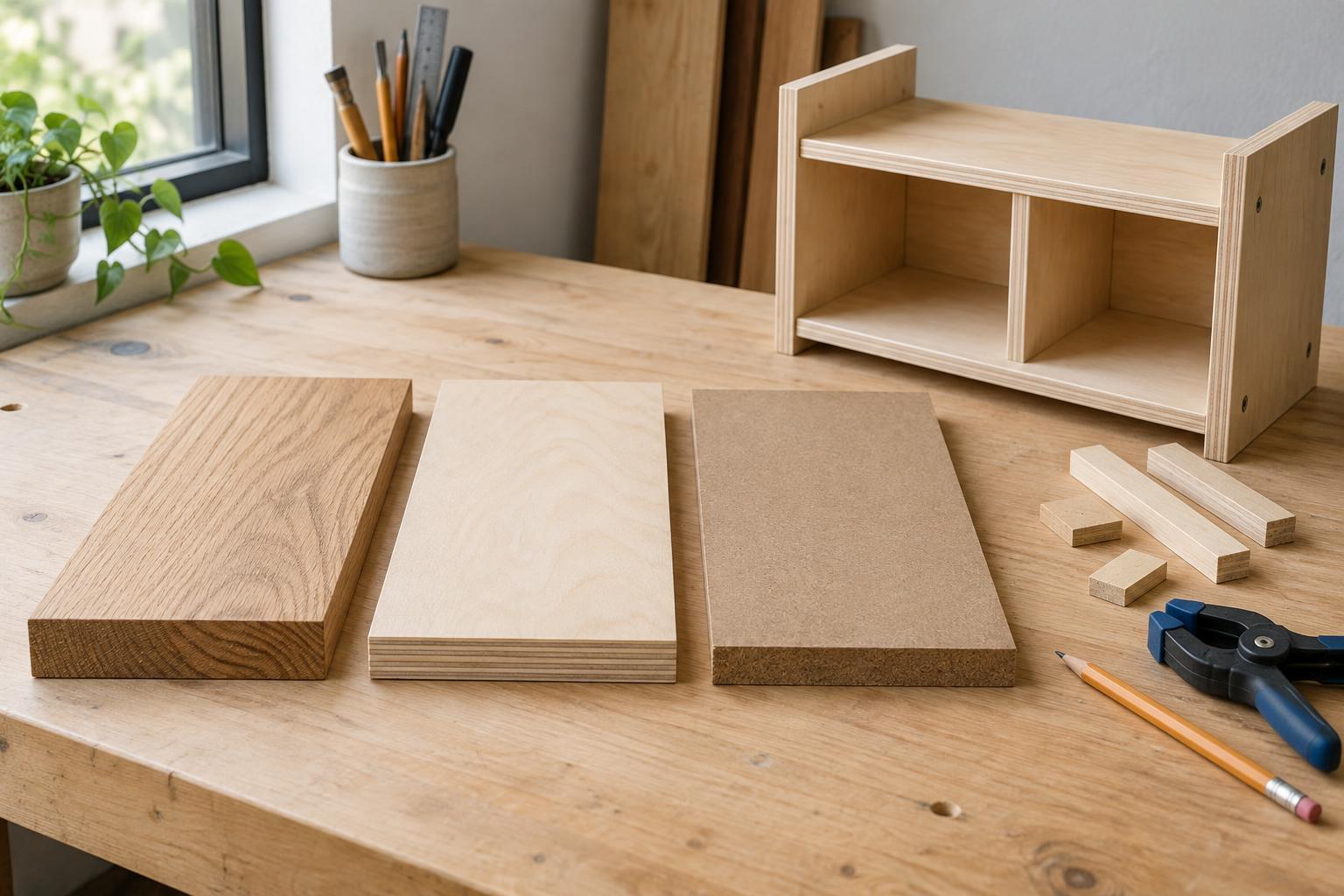
Solid wood, plywood, and medium-density fiberboard (MDF) can all make useful objects. None is the automatic premium option. A neatly painted MDF box can be more appropriate than an elaborate hardwood one; a plywood shelf may be easier to keep flat than a wide solid-wood shelf. The best choice is the material whose strengths match the design, tools, and finish you actually intend to use.
Solid wood: appealing edges, moving boards
Solid wood is a good fit when the grain and edges are part of the design. A small tray, hook rail, or desktop stand can look finished with simple shaping and a clear coat. Edges can be rounded or chamfered without exposing layers or a different core. Scratches and dents can often be sanded and refinished, although the result depends on the depth of the damage and the finish already applied.
Wood responds to changes in indoor humidity by expanding and contracting, mainly across the grain. On a narrow object this may be modest, but on a wide panel it matters when choosing how to attach it to another part. Avoid fastening a wide solid-wood top so rigidly across its width that it cannot move. Solid boards can also arrive bowed or twist after cutting. For a first project, choose straight stock, keep the design simple, and allow enough material to trim pieces square.
Plywood: stable panels with edges to consider
Plywood is made from thin layers bonded with their grain running in alternating directions. That construction makes it useful for flat parts such as shelf panels, box sides, and dividers. It is generally less prone than a comparable solid-wood panel to changing width with seasonal humidity. For a small project, one sheet or offcut can yield several matching parts.
The visible edge is a design decision. You can leave the layers exposed for a deliberate look, cover them with edge banding, or conceal them within a joint. Plywood varies considerably: face veneers may be thin, internal layers may have gaps, and nominal thickness may differ from what a plan assumes. Inspect the edges and faces before buying, and measure the actual thickness before cutting slots or ordering hardware. If you want a clear finish, select a face you are happy to see rather than expecting sanding to fix every defect.
MDF: smooth paintwork, vulnerable edges
MDF is an even, fiber-based panel that suits painted projects with simple, clean surfaces. It has no grain direction to match and no plywood layers to hide. For a small painted organizer or decorative panel, that consistency can make layout and finishing straightforward. It is usually a less satisfying choice when the goal is to show natural material character.
Its edges need attention: they can absorb more primer or paint than the faces, so sealing and sanding between coats helps achieve an even finish. MDF is also heavy for its size, and its edges can be less forgiving of screws than solid wood or suitable plywood. Drill appropriate pilot holes, avoid placing fasteners too close to an edge, and consider glue or a supported joint where practical. Ordinary MDF should be kept away from repeated wetting, which can cause swelling that is difficult to repair.
Make a practical choice and test a scrap
For a clear-finished tray or small stand with visible shaped edges, start by considering solid wood. For a box, shelf, or other panel-based object, consider plywood, especially when flatness and efficient cutting matter. For a painted piece with broad, smooth faces and protected edges, MDF may be the simplest route. These are starting points, not strict rules: the span, joint design, available stock, and tools can change the answer.
Before committing, make one representative corner or edge from an offcut. Cut it with the tools you will use, try the intended fastener or joint, and apply a little of the planned finish. This small test reveals more than a label on a shelf: whether plywood splinters at the cut, whether MDF edges need another coat of primer, or whether a solid board’s grain looks right after finishing. When cutting or sanding any of these materials, control dust, work with ventilation, and use suitable eye and respiratory protection. A material that is pleasant to make with is part of a good design choice.