Start with what the joint must do
Imagine making a small desk tray, book stand or wall-mounted key holder. The pieces may look similar on the workbench, but their joints face different demands. A tray corner needs to stay square as it is picked up. A book stand may be pushed sideways. A key holder has to remain attached while hooks are used. Before choosing a fastener, picture the direction in which the parts could be pulled, twisted or bumped.
Also ask whether the object might need to come apart. A glued joint is intended to be permanent; separating it later can damage the wood. Screws can often be removed, though repeated removal may wear their holes. If you expect to replace a part, adjust the design or transport the object flat, that difference matters as much as strength.
When wood glue makes sense
Wood glue is a good choice when clean, well-fitting wood surfaces can be held together while the glue sets. Broad mating surfaces give it more to work with than a narrow edge or a loose corner. For a simple tray, for example, glue can hold a bottom panel in a groove or secure a small reinforcing block inside a corner. It also leaves no visible screw heads.
Fit matters. Glue is not a reliable substitute for shaping parts that meet properly. Check that the pieces sit together without a large gap, spread the glue as directed on its label, and clamp or otherwise hold the parts in position for the recommended time. Wipe away excess before it interferes with the finish. Let the joint reach its specified cure before putting the object to work; being firm enough to unclamp is not necessarily the same as being ready for use.
Grain direction deserves attention. Gluing the end of one board directly to the face of another creates a joint that may be vulnerable to pulling or twisting because the end grain offers a less favorable bonding surface. A groove, overlap or small corner block can provide better-fitting contact and help locate the pieces during assembly. On a solid-wood panel, avoid locking a wide board so rigidly across its grain that normal changes in humidity have nowhere to go.
When screws are the better tool
Screws are useful when a joint must be assembled quickly, tightened without clamps or taken apart later. They are also convenient for attaching hardware and for holding a replaceable piece. In a small object, a screw can pull two parts together and resist movement in a way that is easy to inspect: you can see where the connection is and whether it has loosened.
Their limits are physical. A screw placed too close to an edge can split the wood, especially in a thin strip. A short screw may not grip enough material, while a long one can emerge through the other side. Drill an appropriate pilot hole, particularly near edges and in harder wood, and consider a clearance hole in the first piece so the screw can draw it snugly against the second. Test the screw length against the actual parts before driving it.
Screws also affect the appearance and feel of an object. Exposed heads may be a deliberate detail on a workshop-style design, but they can catch on items sliding across a tray. Countersinking can set a head below the surface, provided there is enough wood to do so. If a joint is frequently disassembled, a threaded insert or other purpose-made fitting may be worth considering instead of repeatedly driving a wood screw into the same hole.
Using both without making assembly harder
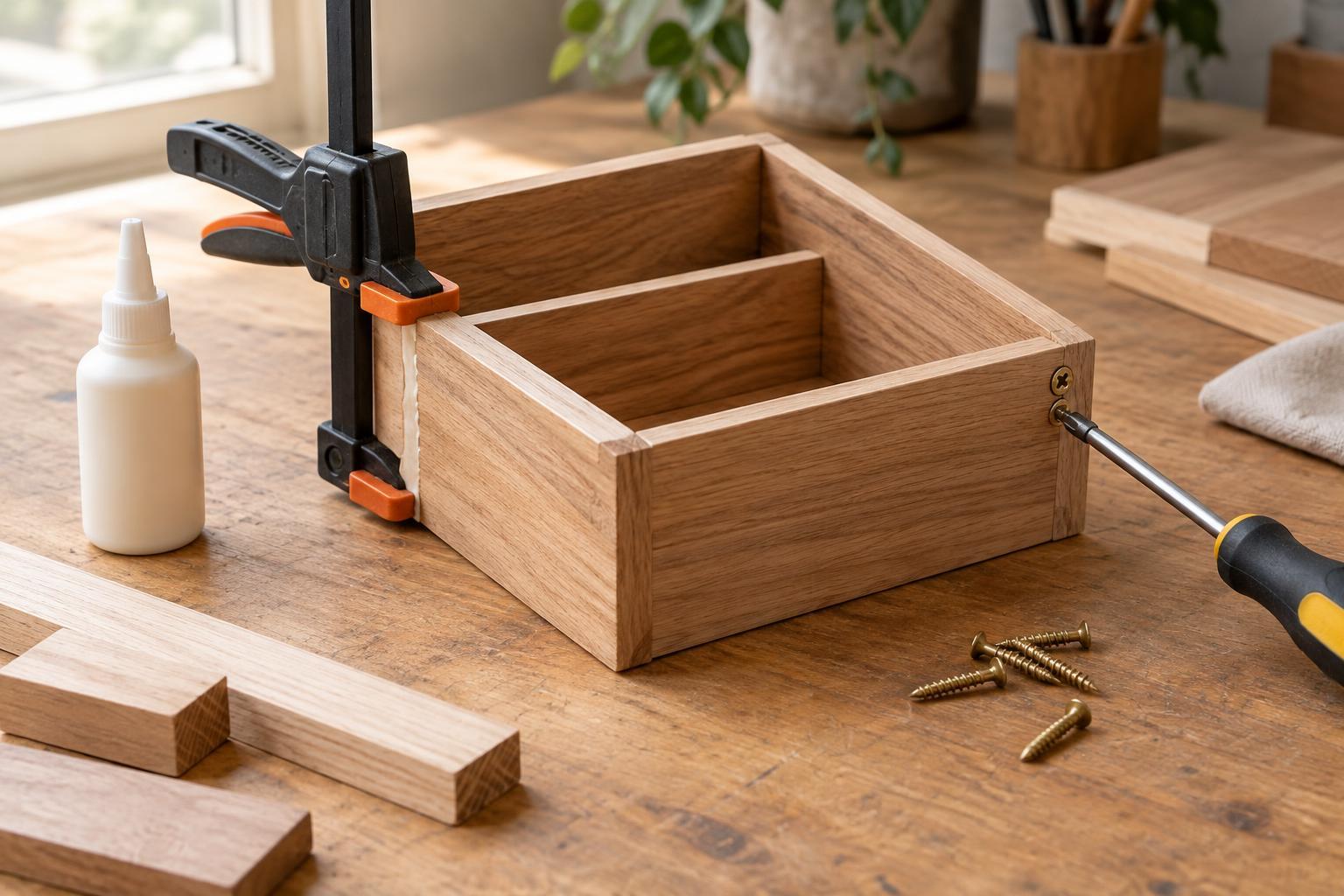
Glue and screws are not opposing camps. A screw can hold a well-fitted joint in position while the glue cures, and glue can add a permanent bond around a mechanically fastened connection. This combination can be handy for a compact shelf bracket or a small box where clamping is awkward. It does not, however, rescue a badly fitting joint or make thin wood immune to splitting.
Plan the sequence before opening the glue. Mark the parts, dry-assemble them, and drill any pilot and clearance holes while everything is easy to handle. Check that tightening a screw will not slide the pieces out of alignment. If the design includes a wide solid-wood panel that needs room to move across its grain, choose an attachment that allows that movement rather than gluing and screwing every edge rigidly in place.
A simple way to decide
For a small wooden object, begin with the joint's geometry. If the pieces meet over a generous, well-fitting area and the object can remain assembled, glue is often the neatest option. If parts need to be removable, clamping is impractical or hardware needs attaching, consider screws. If the joint needs both a permanent bond and help staying aligned during assembly, use both thoughtfully.
Make a quick test from offcuts of the same material when you are unsure. Try the intended joint, then check its fit and how it responds to gentle handling before committing to the finished pieces. A good joint is not simply one that stays together: it is one that suits how the object will be made, used and, if necessary, repaired.